

NATO Approval Sets a New Benchmark for Mobile Security in Critical Infrastructure
What Apple has released:
Apple has announced that iPhone and iPad are now approved for handling information up to NATO Restricted level, becoming the first consumer mobile devices to meet the information assurance requirements of NATO nations.
This approval followed extensive technical evaluation by Germany’s Federal Office for Information Security (BSI) and applies to devices running the latest versions of iOS and iPadOS.
Importantly, the certification is based on the devices’ native security architecture. No special software. No custom modifications. No additional hardening layers.
That alone sets a new benchmark for mobile platforms!

What this means technically:
NATO approval is not a marketing label. It reflects deep architectural trust. The evaluation examined the full security stack, including:
- Hardware-based encryption
- Secure boot and system integrity controls
- Biometric authentication (Face ID)
- Memory protection mechanisms such as Memory Integrity Enforcement
- Ongoing patch management and lifecycle support
This means the core platform itself has been validated to handle classified information under stringent government standards.
In practical terms, the iPhone is not secure because of added tools. It is secure because security is embedded in the silicon, operating system, and device architecture from the start. That distinction matters.

What this means for our industrial clients:
Cybersecurity is now one of the primary operational risks in critical infrastructure.
Energy companies, offshore installations, refineries, process facilities and manufacturing sites are targets of ransomware and state-sponsored attacks. Every device connected to a corporate network represents a potential entry point.
Yet many organizations operating in hazardous (Ex) environments still rely on Android-based industrial devices that:
- Run modified or heavily customized operating systems
- Depend on third-party firmware layers
- Receive inconsistent or short-term security updates
- Follow separate (vs. consumer devices) and sometimes unclear security and OS roadmaps
These devices may meet explosion-protection requirements, but they do not always meet modern enterprise cybersecurity expectations.
From an IT governance perspective, every non-standard platform increases complexity and risk.
The key question becomes:
Can your hazardous-area devices meet the same digital security standards as the rest of your enterprise infrastructure?
With Apple’s NATO approval, the baseline for what “secure” means has shifted.
Bring government-level security into Zone 1 areas:
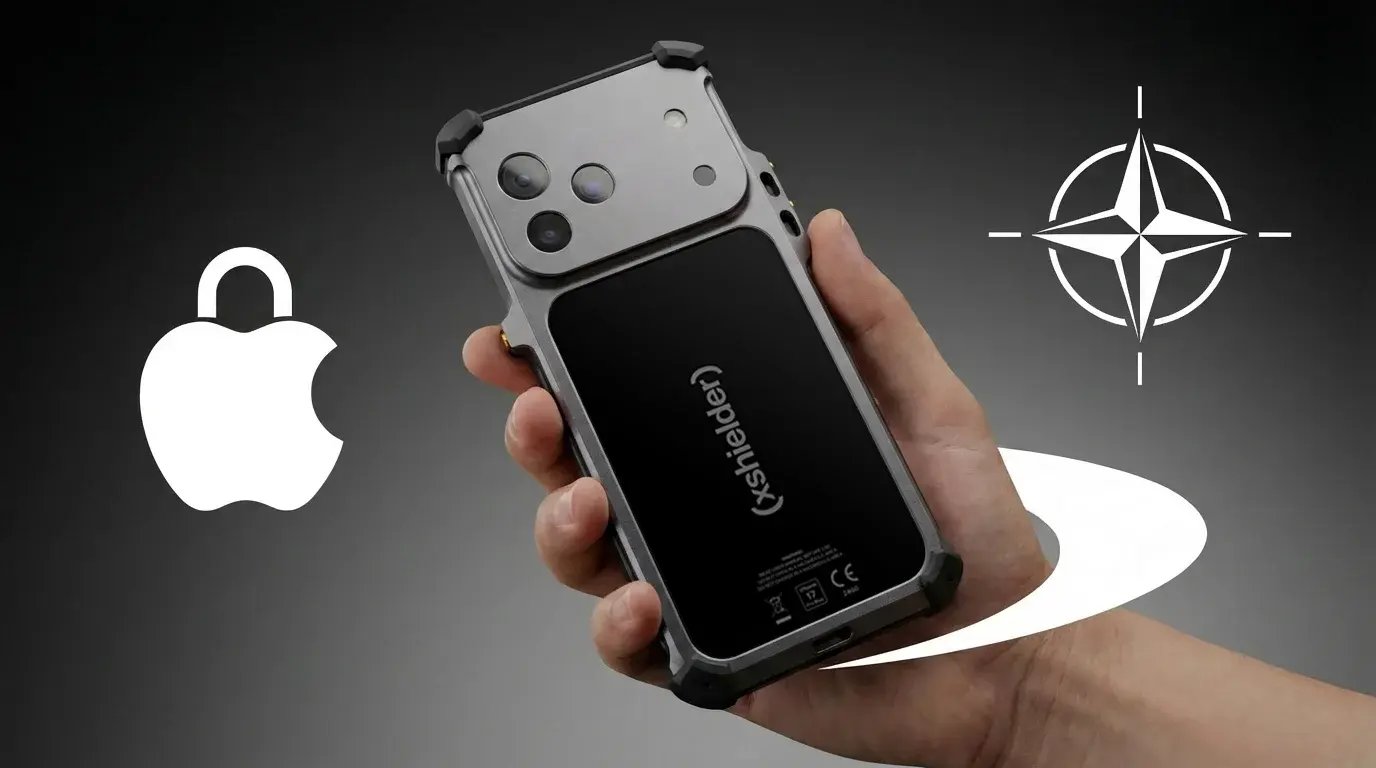
Xshielder builds on Apple’s certified security foundation.
By integrating standard iPhones, such as the iPhone 17 Pro Max, into our patented ATEX and IECEx Zone 1 certified enclosures, we enable operators to deploy:
- A platform cleared for NATO-restricted information
- Fully compliant explosion-proof protection
- Seamless integration with enterprise tools like Microsoft Intune
- Long-term iOS security updates (up to six years)
For IT departments, this means no parallel mobile strategy for hazardous areas.
Policies remain centralized. Security standards remain consistent. Devices follow the same lifecycle as the rest of the organization.
For field operators, it means using the same modern, high-performance platform inside and outside hazardous zones. Explosion protection and cybersecurity does no longer need to be separate conversations.
Read more about the Xshielder iPhone 17 Pro Max here